


 , (2.1)
Nonlinear inversion of 4D seismic datasets in the Eugene Island Block 330 Field of offshore Louisiana, Gulf of Mexico
2.1 Introduction
Parameters derived from seismic reflection data have been used to identify hydrocarbon reservoirs for decades. Variations of seismic amplitude, such as bright-spots and flat spots, are associated with oil- or gas-bearing strata. As 3D seismic technologies merge with the reservoir characterization, acoustic impedances estimated from seismic waveforms are becoming more and more important. Unlike seismic amplitudes, which measure the acoustic impedance variations, the acoustic impedance itself is directly associated with petrophysical properties of sedimentary rocks and the fluids that fill pore spaces. The techniques by which the acoustic impedance are obtained are the bridge connecting reflection seismic data and rock petrophysical properties.
Acoustic impedance volumes estimated from 3D seismic surveys have only recently begun to be used in reservoir characterization. The nonlinear seismic inversion technique described in Chapter 1 is a robust method of estimating acoustic impedance. It contains features particularly useful for analyzing 4D (time-lapse 3D) seismic datasets. The time-variant, dynamic wavelet extraction eliminates the differences caused by most of the post-stack seismic processes applied to the various 3D seismic datasets used in the 4D analysis. The low-frequency constraints imposed on the estimated impedance functions can preserve the unchanging nature of the overall regional geological settings. As a result, dynamic changes of reservoir fluids can be imaged.
In this chapter, we have applied our nonlinear seismic inversion technique (see Chapter 1) to two time-lapse 3D seismic datasets to estimate acoustic impedance volumes in the EI-330 minibasin. The same geological and geophysical constraints derived from well log analysis are incorporated into the nonlinear seismic inversion of both seismic datasets. Both the technique and procedure used to construct the acoustic impedance constraints are presented in detail. Independent estimations of the accuracy and reliability of the estimated acoustic impedance are performed using acoustic well logging data. Our seismic inversion technique is found to be stable and consistent throughout the computation.
2.2 Geological background
The Eugene Island (EI) 330 minibasin is located approximately 270 Km southwest of New Orleans (Figure 2.1), which is one of the most prolific minibasins in the offshore Gulf of Mexico region. The EI-330 minibasin is oblong, approximately 19 Km by 15 Km (11.9 miles by 9.4 miles), and fault-bounded. It sits on a major shelf margin deltaic depocenter of Plio-Pleistocene age. Hydrocarbons of the EI-330 Field are produced from over twenty-five different Plio-Pleistocene sand reservoirs that are segmented into at least a hundred structural and stratigraphic traps (Holland et al., 1990).
Alexander et al. (1995) suggest that the minibasin evolved in three phases: prodelta, proximal deltaic, and fluvial. In the prodelta phase, bathymal and outer neritic shales and turbidites loaded and mobilized an underlying salt sheet. During the proximal deltaic phase, salt continued to withdraw from beneath the minibasin and lowstand shelf margin deltas deposited large volumes of sediment. Regional growth faults bound the northern margin of the minibasin. Sediment accumulation and fault slip rates were high as thick sequences of deltaic sands were deposited adjacent to the fault system. During the final fluvial phase, salt withdrawal waned, and the creation of accommodation space within the minibasin ceased. The minibasin was filled and lowstands deltaic systems prograded southward (Alexander et al., 1995). Most of the hydrocarbon reservoirs discovered in the EI-330 Field were formed during the second and third phases. The seismic data input to the nonlinear inversion has a time window large enough to include all major sand reservoirs in the study area (0-3 seconds).
2.3 4D seismic datasets: registration and wireline logging database
Since the discovery of the EI-330 Field, more than five hundred wells were drilled to explore and produce this most prolific oil field in offshore US. Gulf of Mexico. Well data collected in this area from several oil companies provide substantial control to the inversion and subsequent analyses. In addition to extensive 2D seismic surveys, three partially-overlapping 3D seismic surveys have been acquired since 1985. Two of the 3D seismic surveys, acquired in 1985 and 1992 (Figure 2.1), were selected for 4D analysis. The overlapping area is centered at the Block 330/331 boundary and covers approximately equal amounts of each block (Figure 2.1). Structurally, this area is situated on the western flank of the Block 330 roll-over anticline, which forms the closure trapping hydrocarbons against the northern growth fault system.
2.3.1 Registration of 4D seismic datasets
To date, no 4D seismic dataset has been acquired for the expressed purpose of fluid monitoring in the offshore Gulf of Mexico. The 3D seismic surveys were acquired with different orientations and spacings, and processed with different parameters by different geophysical service companies. Despite these disadvantages, we found that these "legacy" 4D seismic datasets are sufficiently similar to be used for fluid monitoring purposes.
Legacy 4D seismic datasets must be properly registered in space and time. Differences between the results of two surveys can be caused by differences in seismic data acquisition and processing as well as by dynamic changes that occur in the reservoirs. Changes caused by data acquisition and processing must be eliminated before hydrodynamic changes can be identified. Difference caused by acquisition in different directions, at different spacing or different cable length, cannot be corrected after stacking and migration have been performed. Fortunately, modern seismic imaging technologies are much better than a decade ago. Difference due to different directions are often small in areas of low subsurface relief such as the Eugene Island Area. Especially helpful: the 1985 3D survey was re-processed in 1992 using new processing techniques.
The general geology (locations of faults geometry, lithology and porosity) should be in the same location between the surveys. Indeed, the two 3D seismic datasets are remarkably similar, at least in regions where no steeply dipping geological structures (salt and large faults) occur. Salt withdrawal structures do occur in our study area, but do not distort the seismic images of the hydrocarbon reservoirs because they are usually deeper. We assume that the differences observed in the stacked and migrated datasets are dominantly affected by hydrocarbon drainage caused by production and different post-stack processing parameters, and not by different acquisition geometry.
The 1985 seismic survey was acquired in the northwest-southeast oriented lines, while the 1992 survey was acquired in north-south lines (Figure 2.1). The "bin" spacing of the two surveys is also different. A re-gridding process is applied to relocate the two surveys into a common grid before any further seismic analysis is performed. We use an algorithm that interpolates one three-dimensional mesh into another three dimensional mesh slice-by-slice in traveltime and orient the 1985 seismic survey onto the 1992 grid. The algorithm computes the areal weights in a moving window in depth, and interpolates new data values into the destination survey coordinates. After the re-gridding process, only data points common to both surveys are preserved, the rest being assigned null values (Figure 2.2) and (Figure 2.3). Seismic sections extracted from these two volumes at the same location from the two volumes are generally similar, although some differences are evident (Figure 2.4) The loss of high frequency content in seismic data becomes significant in the deeper portion of seismic volumes.
Spectral matching between the two seismic datasets is not necessary in the seismic inversion approach to the analysis of 4D seismic datasets, unlike 4D seismic amplitude differencing technologies (Anderson et al., 1995). But phase matching is performed in order to compare the inversion results. Our nonlinear inversion technique (Chapter 1) is capable of eliminating other post-stack processing artifacts using dynamically extracted seismic source functions. However, since the true amplitudes of seismic datasets are unknown, amplitude renormalization must be performed. We first normalize each seismic volume by mapping the histogram of amplitudes onto one another. The normalized seismic traces are rescaled to the proper amplitude by comparing them to synthetic seismograms computed from impedance measurements (i.e., sonic and density logs) from wells in the area. Scaling factors of 0.15 and 0.25 are used for the 1985 and 1992 seismic surveys, respectively. The extracted seismic source functions are normalized to unity so that the reflectivity functions derived from the estimated acoustic impedances are realistic (i.e., within the range of +/-0.15). Normally, Tertiary sedimentary basins filled with sand and shale sequences have true seismic amplitudes less than +/-0.3.
2.3.2 Digital wireline logging database
The nonlinear inversion of seismic data requires a good a priori reference model. There are more than seventy wells (Figure 2.5) in our study area overlapped by the two seismic datasets (Figure 2.2) and (Figure 2.3). However, sonic and bulk density logs which are needed to compute impedance are only available in fourteen of these wells. The limited sonic data availability may be overcome by using the correlation between sonic and other logs to empirically calculate a "pseudo" sonic log (a common technique in petrophysical analysis). In wells without density logs, we use the inverse Gardner relationship to calculate density logs from measured or estimated sonic logs (Gardner et al., 1976).
2.4 Well log analysis for the impedance inversion
The band-limited nature of observed seismic datasets requires that the estimated acoustic impedance functions, i.e., the short-wave length model parameter (Tarantola, 1982 and 1984), should also be within a confined frequency bandwidth in order to have physical meanings. Detailed trend analysis for predicting long-wavelength constraints on impedance is essential. Such constraints derived independently from acoustic measurements in wells, not only increase accuracy of the estimated impedance, but also stabilize the iterative seismic inversion (He et al., 1995). The low-frequency impedance constraints derived from well logs are sufficient to allow our nonlinear seismic inversion to converge on true acoustic impedance solutions.
2.4.1 The principles of wireline logging and data interpretation
Geophysical log data are recorded using probes which are lowered on the end of a wireline through the drillpipe and into the previously drilled borehole. The depth at which the measurements are made is determined by measuring the length of cable run into the hole. Modern logging technologies can measure many different physical properties. Three major types of log data are in general available for well data analysis: electrical, radioactive, and sonic logs. The well log database in our study area includes natural gamma ray (GR), spontaneous potential (SP), resistivity (RES), induction (ILD), bulk density (RHOB), sonic (DT), and caliper (CALI) measurements. Some wells also contain porosity measurements made on side-wall cores.
The natural gamma ray log utilizes a scintillation detector to measure the natural radiation emitted by the rocks surrounding the borehole. The response of the tool is a simple function of the concentration by weight of radioactive materials and the rock density. The average investigation depth into sedimentary formations is about 0.3 m, and actual resolution is 0.15 m. GR is used principally as a sand/shale discriminator since shales contain abundant radioactive minerals such as clays, whereas sandstones do not.
Density is measured by the lithodensity logging tool. A radioactive source is mounted in the tool body, and a bow-spring forces it and a pair of detectors against the borehole wall. The two detectors measure the returned flux of scattered gamma rays in a series of energy bands, which is used to determine formation density (RHOB) and photo-electric factor (PEF). A measure of tool performance based on the energy distribution at the near and far receivers (DRHO) is also provided. The interaction between the gamma ray and electrons in the formation causes Compton scattering. The density logging tool measures electron density directly, and formation density is determined using the fact that in most rock-forming elements atomic weight is roughly twice atomic number. This measurement is almost independent of porosity and can be used as a matrix lithology indicator. The depth of investigation of the lithodensity tool depends on the density of the rock: the higher the density, the lower the penetration. In porous and permeable formations, the density tool does not read deeper than 0.15 m. The vertical resolution is about 0.3 m.
The array induction tool string indirectly measures electrical resistivity and gamma ray "shaliness", which are related to porosity and hydrocarbon content. The array induction tool is a resistivity logging device that provides measurements of spontaneous potential (SP) and resistivity. Resistivity is reported for three different depths (deep, medium, and shallow).
Differences between shallow and deep resistivity measurements can be related to the invasion of drilling fluids into permeable horizons. Resistivity is controlled mainly by the amount and connectivity of the porosity and the conductivity of the pore fluids, since the solid constituents are orders of magnitude more resistive than pore fluids in most rocks.
Sonic tools are designed to measure the compressional wave velocity of the rock surrounding the borehole. The sonic tool can be thought of as a miniature seismic refraction experiment carried out within the cylindrical borehole. The tool is centered in the hole by means of bowsprings, and contains one or more acoustic sources and receivers. A source emits acoustic waves that are transmitted into the borehole fluid. A refracted compressional wave is generated when the wavefront impinges on the borehole wall. Waves arrive at the receivers at a time which is linearly proportional to their offset from the source. Compressional wave velocities can be determined by differencing the arrival times at multiple receivers a known distance apart.
The Caliper log measures wellbore diameter, and is run at the top of both array induction and sonic combinations. It is primarily used to indicate "washouts", where other logs may read inaccurately, and to correct logs whose response is sensitive to hole diameter. However, caliper response can also be indicative of lithology. For instance, in zones with swelling clays, hole constrictions are observed where the caliper reads less than the bit size. Variations in hole diameter may correlate with lithologic changes, since hole conditions are in general a consequence of rock properties.
Lithology can be obtained from GR and SP logs. Resistivity and induction logs are used to identify pore fluid composition. Formation porosity is one of the primary physical property measurements made in a wellbore, and direct measurements are made by neutron logging tools. The difference between thermal and epithermal neutron porosity is a measure of the amount of bound water in clay minerals. Since neutron logging tools were not run in most of production wells drilled in the study area, porosities in our wellbores are indirectly derived from sonic, density, and resistivity logs. The relationship between resistivity and porosity has been quantified by "Archie's Law" (Archie, 1942), which relates the resistivity to an inverse power of the porosity. This empirical relationship works reasonably well in the sands found in hydrocarbon reservoirs.
2.4.2 Well log interpretation for nonlinear seismic inversion
The estimated acoustic impedance functions are sampled in traveltime whereas well logs are sampled in depth. We converted logs from depth to two-way traveltime using sonic logs and velocity measured by "checkshot" vertical seismic profiles (VSP). Synthetic seismograms, generated from the sonic logs, are compared with seismic data to verify the depth-time conversion.
2.4.3 Acoustic velocity and density logs estimated from other logs
Empirical relationships between well logs have been widely used in the oil industry for many years. In wells that have only density logs, the pseudo-sonic velocity can be estimated using the Gardner's relationship (Gardner et al., 1974):
, (2.1)
where  is the sonic
velocity and
is the sonic
velocity and  is
the bulk density. In wells with neither sonic nor density logs,
the pseudo-sonic log can be computed from porosity,
is
the bulk density. In wells with neither sonic nor density logs,
the pseudo-sonic log can be computed from porosity,  ,
shale volume fraction,
,
shale volume fraction,  ,
using the time-average equation:
,
using the time-average equation:
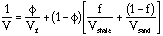 . (2.2)
Here  is the acoustic
velocity of pore fluids,
is the acoustic
velocity of pore fluids,  is the acoustic velocity of pure shale and
  is the acoustic velocity of pure sand. Using the gamma ray logs,
sand and shale compaction curves can be regressed from the extracted
pure sand and shale reciprocal velocity in depth (Figure 2.6).
The sand and shale compaction curves in the study area are given
by:
is the acoustic velocity of pure sand. Using the gamma ray logs,
sand and shale compaction curves can be regressed from the extracted
pure sand and shale reciprocal velocity in depth (Figure 2.6).
The sand and shale compaction curves in the study area are given
by:
 , (2.3)
respectively, where  and
and  are velocities
of sand and shale in m/s, and z is the depth in meter. The sand
and shale compaction curves intersect each other at about 1,067
m, indicating that the acoustic velocity of shale sequences exceeds
that of sand sequences at greater depth.
are velocities
of sand and shale in m/s, and z is the depth in meter. The sand
and shale compaction curves intersect each other at about 1,067
m, indicating that the acoustic velocity of shale sequences exceeds
that of sand sequences at greater depth.
The fractional porosity,  ,
in Eq. 2.2 can be computed from resistivity logs using Archie's
Law (Archie, 1942):
,
in Eq. 2.2 can be computed from resistivity logs using Archie's
Law (Archie, 1942):
 , (2.4)
where  and
and  are constants empirically determined and R is resistivity in
  .
.
 = 0.125 for sand
and 0.08 for shale, and n = 0.5 in our study. Fractional shale
volumes, f, can be computed by (Brock, 1984):
= 0.125 for sand
and 0.08 for shale, and n = 0.5 in our study. Fractional shale
volumes, f, can be computed by (Brock, 1984):
 (2.5)
(2.5)
or
 . (2.6)
Here f is the shale volume fraction,  and
and  are empirical
constants (we use 0.21),
are empirical
constants (we use 0.21),  and
and  are gamma
ray and spontaneous potential indices, respectively.
are gamma
ray and spontaneous potential indices, respectively.  and
and  are computed
from the equations (Schlumberger Log interpretation Principles/Application,
1989):
are computed
from the equations (Schlumberger Log interpretation Principles/Application,
1989):
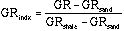 (2.7)
(2.7)
and
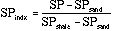 . (2.8)
Here  and
and  are the measured gamma ray intensities in API and spontaneous
potential in mV respectively. The subscripted quantities represent
the sand and shale baseline values read from the corresponding
logs.
are the measured gamma ray intensities in API and spontaneous
potential in mV respectively. The subscripted quantities represent
the sand and shale baseline values read from the corresponding
logs.
Velocity-depth profile varies laterally due to formation structure and stratigraphy. We compensate by adjusting the regressed sand and shale compaction curves according to stratigraphic horizons in our study area. For example, the structure maps of two sand tops (the tops of JD and LF reservoirs) indicate that the sands dip about 20 degrees westwards along the west flank of the EI-330 roll-over anticline (Figure 2.7). The regressed sand and shale compaction curves are adjusted for the amount of structural uplift at each well location by an amount determined from wells with sonic measurements. The low-frequency trends are consistent with both geological structure, and direct measurements made in neighboring wells. Both the measured and estimated pseudo-sonic logs were then used to compute acoustic impedance logs and to convert logs in depth to logs in two-way traveltime.
When no density log is available for a well, the pseudo-density log can be computed from the sonic log by using the inverse Gardner relationship:
 . (2.9)
Here  is density
and V is the acoustic velocity.
is density
and V is the acoustic velocity.
Calibrations are performed on wells with full suites of log measurements to determine the constants in the above empirical relationships. (Figure 2.8) shows the comparison between the measured and computed sonic and density logs in well 331_SH_A-1. Due to the crossover of the sand and shale compaction curves, the sand sections are high-velocity anomalies in the shallow portion of the well (above 1067 m) and are low-velocity anomalies at depth. We can see that the estimated velocity and density logs are very similar to the measured logs. The low-frequency trend in the estimated pseudo-velocity log agrees with the measured trend as well. The relative error between the estimated and measured velocity logs is 6% and that of density logs is 6.7%. The comparison between the estimated acoustic impedance logs is shown in (Figure 2.9). The average relative error between the estimated and measured impedance logs is 5.5%. The velocity, density, and acoustic impedance logs are in agreement throughout the depth range, justifying the use of the empirical relationships. These results also indicate that superimposing the regressed low-frequency trend of velocity to the high-frequency velocity variations derived from resistivity and lithology logs is viable. We will also use only the low-frequency impedance functions to constrain the estimation of high-frequency impedance functions.
The seismic section in (Figure 2.9) is an arbitrary seismic line extracted from the 1985 seismic survey. Several sand tops identified in well logs show good ties with the corresponding seismic reflectors in traveltime (Figure 2.10).
2.4.4 A priori acoustic impedance model construction
The nonlinear inversion employs a one-dimensional inversion algorithm. An a priori impedance model has to be constructed for each trace of both 3D seismic surveys. We use impedance logs from twelve wells with sonic and density measurements in the study area to construct the reference impedance model. The acoustic impedance logs from these twelve wells are first analyzed to extract compaction trends at each location. Depth is then converted to two-way traveltime using the velocity logs at each well (Figure 2.11). We then construct a 3D impedance model by linearly interpolating these impedance trend curves into the common seismic grid. The interpolated 3D impedance model contains only the low-frequency trend of the acoustic impedance function. Each vertical trace of this model is then treated as the a priori impedance model and the initial model for the corresponding seismic trace.
Data and model space covariance functions are also needed to constrain the inversion process, in addition to an a priori impedance model. These covariance functions represent uncertainties associated with data and model parameter optimizations. Details are addressed in the next section.
2.5 Nonlinear inversion of 4D seismic datasets
The two seismic datasets are independently inverted with the same a priori low-frequency impedance and initial impedance models. The covariance functions that describe uncertainties in estimated impedance functions and the observed seismic traces are treated in the same manner for each seismic trace of both seismic surveys, so the inversion of the two seismic datasets is under a uniform constraints and uncertainties.
2.5.1 Dynamic extraction of seismic source functions
The first step of the full-scale nonlinear seismic inversion is to extract seismic source functions from the observed seismic trace. We dynamically extract a time-variant source function from each seismic trace in the dataset. The time-variant source function actually contains three source functions that are applied to different time windows within the seismic trace. These source functions are determined from a moving-window autocorrelation function computed for each seismic trace, along with assumption that they are zero-phase. These dynamic source functions eliminate data processing artifacts that were introduced by using different processing parameters after the stacking and migration processes. Using the method, the spatial variation of frequency bandwidth of the impedance function in the estimated acoustic impedance volumes are made internally consistent.
Two seismic traces extracted from the same location of the 1985 and 1992 3D seismic surveys are shown in (Figure 2.12). The corresponding time-varying autocorrelation functions are shown in (Figure 2.13) and (Figure 2.14). The two traces have significant differences in frequency content and shape. The trace from the 1992 survey has the higher data quality, but its frequency content is lower than that of its 1985 counterpart. Frequency segmentation observed in both traces suggests that three seismic source functions are necessary to properly retain the frequency bandwidth of the estimated impedance functions, acting in three distinct time windows (0-1 seconds, 1-2 seconds and 2-3 seconds) (Figure 2.13) and (Figure 2.14). Similar behavior is observed in other traces within the surveys, leading us to use three seismic source functions in three time windows for the inversion.
2.5.2 Estimation of impedance volumes from 4D seismic dataset
We focus on seismic data from 0.9 to 2.8 seconds two-way traveltime. Each seismic trace in these surveys is sampled at 4 ms interval and contains 476 samples. The full-scale nonlinear seismic inversion is applied to each seismic trace of both surveys independently. The similarity in the estimated acoustic impedance volumes is an independent check of the success of the inversion.
The seismic data contain multiple reflections, side reflections, and noise which affect the quality of the inversion. This contamination is modeled as random noise described by a Gaussian data covariance functions. Uncertainty in the model parameters are also modeled by a Gaussian distribution law. The a priori acoustic impedance at each sample location is expressed in terms of a mean and a covariance. The covariance expresses our degree of certainty that the true impedance is close to the a priori impedance. We use the low-frequency impedance model derived from well logs in section 2.4.4 as the a priori impedance. The variance of the impedance is taken to be about 20% of its mean.
The computational steps taken in the inversion of 1985 and 1992 seismic volumes are summarized as follows:
Step 1: Extract the time-varying seismic source functions,  ,
from the seismic trace,
,
from the seismic trace,  .
Seismic source functions for each seismic trace are extracted
independently throughout the seismic volume.
.
Seismic source functions for each seismic trace are extracted
independently throughout the seismic volume.
Step 2: Construct the a priori reference model of the impedance
function  using
log data in the entire seismic volume (we used only twelve wells
with impedance measurements, other wells are used to examine the
inversion results). Its covariance function
using
log data in the entire seismic volume (we used only twelve wells
with impedance measurements, other wells are used to examine the
inversion results). Its covariance function  is given by:
 . (2.10)
Here  is a variance
of the i-th sample of the impedance function (20% of the a
priori impedance), and
is a variance
of the i-th sample of the impedance function (20% of the a
priori impedance), and  is the time window over which one expects the estimated impedance
to be smooth,
is the time window over which one expects the estimated impedance
to be smooth,  = 28 ms (7 samples at the 4 ms sample rate).
Step 3: Construct the covariance function of the seismic data,
 , using:
 . (2.11)
Here  is the variance
of seismic amplitude at the i-th sample (taken as 10% of the absolute
maximum seismic amplitude of the entire seismic volume). The correlation
length,
is the variance
of seismic amplitude at the i-th sample (taken as 10% of the absolute
maximum seismic amplitude of the entire seismic volume). The correlation
length,  , is also
set to 28 ms (7 samples at the 4 ms sample rate).
, is also
set to 28 ms (7 samples at the 4 ms sample rate).
Step 4: Compute the objective function,  ,
starting from an initial impedance function,
,
starting from an initial impedance function,  .
We set the initial model equal to the a priori impedance,
.
We set the initial model equal to the a priori impedance,
 . The modeled seismic
trace
. The modeled seismic
trace  is generated
by convolving
is generated
by convolving  with the reflectivity function derived from
  in the three different time windows. The objective function,
  ,
at
,
at  is then computed
as:
is then computed
as:
 .(2.12)
Step 5: Compute the gradient matrix of the objective function with respect to each model parameter by using the forward difference algorithm:
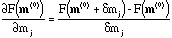 . (2.13)
Step 6: Reduce the objective function  by searching for a perturbation,
  ,
which updates the current model,
,
which updates the current model,  .
This step is accomplished in the modified Levenberg-Marquardt
algorithm. The new model
.
This step is accomplished in the modified Levenberg-Marquardt
algorithm. The new model  becomes the current model.
Step 7: Test for convergence. Terminate the iteration when the
relative reduction of the objective function in two consecutive
iterations is less than  or if the objective function is less than
  .
Otherwise, the inversion process reverts to Step 4.
.
Otherwise, the inversion process reverts to Step 4.
Estimated impedance volumes, and corresponding wavelet (source function) volumes have been derived for the 1985 and 1992 datasets (Figure 2.15), (Figure 2.16), (Figure 2.17), and (Figure 2.18). The seismic source function volumes differ in both frequency content and smoothness, with the 1992 source functions being smoother.
2.6 Discussion and conclusion
Like the seismic volumes, the estimated 1985 and 1992 acoustic impedance volumes are in general similar to one another. However, significant small-scale differences, occur. These changes are possibly caused by hydrocarbon production drainage in reservoirs.
Vertical wells drilled in offshore oil fields are rare, most of the wells were drilled with deviations. Thus the best way to compare the estimated impedance functions with the measurements from logs is to use arbitrary impedance cross-sections that follow the deviation pattern of the wells. (Figure 2.19) (a) is the G-G' cross-section extracted from the 1985 impedance volume that passes platform A in Block 331 and platform B in Block 330. (Figure 2.19) (b) is the same cross-section extracted from the 1992 impedance volume. For clarity, only two wells, 331_SH_A-23 and 330_PZ_B-9, drilled exactly along this section (Figure 2.19) (a) and (b) are displayed along with the seismic data. The sonic and GR logs are displayed along well path. Sonic logs are displayed to the left of the well path, and GR logs to the right. Excellent match can be seen between the sonic logs and estimated impedance section along the well paths on both sections. The low impedance anomalies are often correlated to the hydrocarbon reservoirs.
There is significant evidence for hydrocarbon drainage from areas of low impedance observed in 1985. In 1992, these regions have patched of both increased impedances and decreased impedances. The increase in acoustic impedance often indicates that reservoir voids which were occupied by hydrocarbons in 1985, have been replaced by formation brine by 1992 (Anderson et al., 1995).
2.6.1 Accuracy and reliability of estimated impedance volumes
Evaluation of the estimated acoustic impedance volumes is usually difficult to implement because we do not have exact knowledge of the acoustic properties in the entire sediment volume. We analyze the accuracy and reliability of our inversion results by examining the estimated impedances by using sonic, density, GR, and resistivity logs. These well logs are well-correlated to the acoustic impedance, in general. Because the initial and a priori impedance models are based on only the low-frequency part of impedance logs, the high-frequency data from those wells constitute independent data.
We compare the estimated acoustic impedance volume of the 1992 survey to these independent well log data. (Figure 2.20) shows the structure map of the top of LF sand, one which, we have annotated the locations of cross-sections, C-C', D-D', E-E', F-F', and H-H'. These acoustic impedance cross-sections along with the well logs which intersect the cross-sections are illustrated in (Figure 2.21), (Figure 2.22), (Figure 2.23), (Figure 2.24), and (Figure 2.25). Good agreement between the location of hydrocarbon reservoirs and low acoustic impedance anomalies is observed on all of these cross-sections.
We plotted the measured impedance log in a vertical well, 331_SH_1, against the estimated acoustic impedance function in (Figure 2.26). The estimated impedance function has the same low-frequency trend as the impedance log. The high-frequency content in the estimated impedance is not as high as that of the impedance log. However, the relative error between the impedance log and the estimated impedance function in well 331_SH_1 is small, only 8.0%. A good linear correlation is observed between the impedance log and the estimated acoustic impedance (Figure 2.27). Similar results were also obtained from several other logs.
These tests demonstrate that the estimated acoustic impedance volumes are acceptable for use in 4D and other geological analyses. Although the estimated impedance function has less resolution than the sparsely-distributed well logs, the lateral continuity makes the impedance results much more useful.
2.6.2 Conclusion
We have developed a full-scale, nonlinear 4D seismic inversion technique to invert two time-lapse, 4D seismic volumes under low-frequency acoustic impedance constraints. Prior to the inversion process, a priori information about the acoustic impedance model is constructed from a limited number of wells that have sonic and density logs. We do not use all available wells to construct the reference impedance model, so that control wells can be used after the inversion to analyze the reliability and accuracy of the computed impedance volumes. Independent examinations of the estimated acoustic impedance volumes using these control well logs indicate that the inversion is able to recover accurate acoustic impedance functions to less than +/-10%. The consistency observed between impedance volumes suggests that our nonlinear inversion avoids serious artifacts.
The geological features observed in the two impedance volumes are remarkably similar. Good agreements between the estimated impedance functions and well logs are observed, suggesting that the nonuniqueness of the estimated impedance volumes is not significant. The impedance volumes are now ready for 4D seismic monitoring analysis (Chapter 3) and reservoir characterization (Chapter 4).
Time-varying seismic source functions are also obtained for all seismic traces in the two inverted seismic data volumes. These wavelets may be of some usefulness in estimating spatial frequency variations caused by both acquisition and processing variability. We have not implemented phase adjustment into source extraction process. In the future, such refinements may further improve the inversion process.
Our estimated impedance volumes are well-behaved and laterally continuous. We believe that the integration of high lateral resolution from the estimated acoustic impedance volumes and high vertical resolution from sparsely-distributed well logs can be used to achieve a much better characterization of changes in oil and gas reservoirs over time than today's standard analysis techniques.
References
Alexander, L., and P.B. Flemings, 1995, Geologic evolution of a Plio-Pleistocene salt-withdrawal minibasin: Eugene Island Block 330, Offshore Louisiana: American Association of Petroleum Geologists Bulletin, v. 79, p. 1737-1756.
Anderson, R.N., A. Boulanger, W. He, Y.F. Sun, L. Xu, and B. Hart, 1995, 4-D seismic monitoring of drainage in the Eugene Island 330 Field in the offshore Gulf of Mexico: American Association of Petroleum Geologist special publication, in press.
Archie, G.E., 1942, The electrical resistivity log as an aid in determining some reservoir characteristics: Transactions AIME 146, p. 54-62.
Brock, J., 1984, Analyzing Your Logs, Vol. II-Advanced Open Hole Log Interpretation: Petromedia, Tyler, 173 p.
Gardner, G.H.F., L.W. Gardner and A.R. Gregory, 1974, Formation Velocity and Density-The Diagnostic Basics for Stratigraphic Traps: Geophysics, V. 39, No. 6, p. 770-780.
He, W., R.N. Anderson, and Y.-C. Teng, 1995, Application of seismic inversion to quantitative mapping geopressure transition zones in the Pleistocene, offshore Louisiana, Gulf of Mexico: The 2nd International Conference on Theoretical and Computational Acoustics, Honolulu, Hawaii.
Tarantola, A., and B. Valette, 1982, Inversion = Quest for information: Geophysics, v. 50, p. 159-170.
Tarantola, A., 1984, Inversion of seismic reflection data in the acoustic approximation: Geophysics, v. 49, p. 1259-1266.


